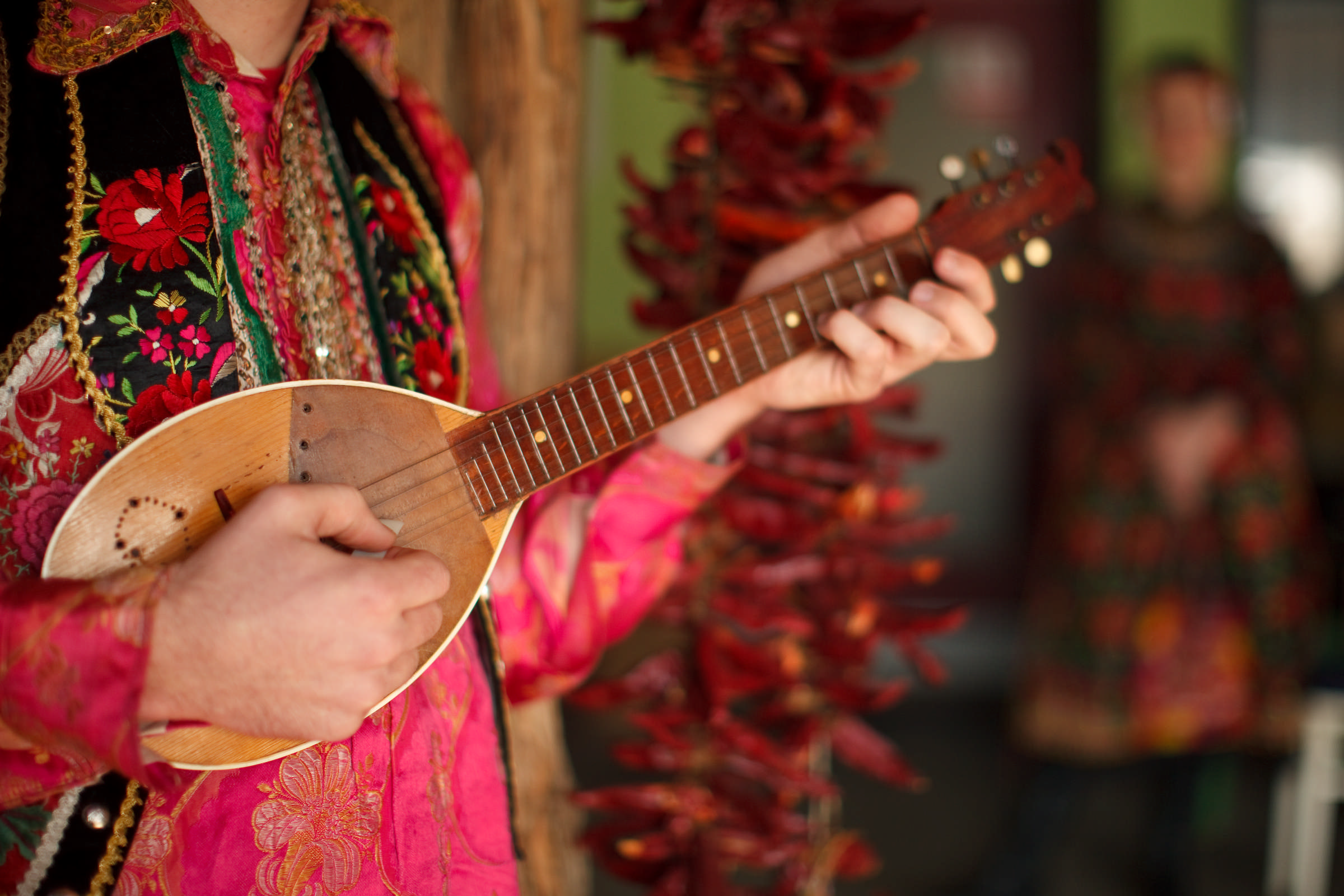
INTRODUCING THE TAMBURICA… Be it in a concert venue or in a local restaurant, the tamburica strikes the same chord of emotion
Mario Zbiljski, Davor Bobić and Dinko Glavaš talk about the past, present and future of tamburitza music
When it comes to tamburica music, Osijek has never been in a better place, says Mario Zbiljski, named Croatia’s best tamburica instrumentalist by the Croatian Musicians Union, recipient of the 27th Porin Award for the best folk music album. “Nowadays we have the Pajo Kolarić Orchestra, which is an academic ensemble, the Franjo Batorek Tamburica School, and the Franjo Kuhač Music School Orchestra, whose 16-year-old Petar Vlajčić is a top soloist and national champion in his category,” explains Mario proudly.
He recalls that the first person to open the doors of classical music to the tamburica was Hrvoje Majić, the lead player (primaš) of Zlatni Dukati, in the early 1990s. “That idea caught on with me too,” says Zbiljski. “Majić was a pioneer, and the rest of us made our own plans to keep developing it.” According to him, tamburica music evolved in two directions: “One was the professional, tavern-style path – as Josip Andrić wrote in Tambura Paje Kolarića – when five or six players would gather to perform their own arrangements for entertainment. The other was cultural amateurism, where orchestras performed composed tamburica works and classical arrangements.”
Zbiljski se prisjeća kako je tamburi u klasičnoj glazbi prvi otvorio vrata Hrvoje Majić, primaš iz Zlatnih dukata, ranih 90-ih prošloga stoljeća. Ta se ideja tada „primila“ i kod Zbiljskog. „Hrvoje Majić bio je pionir, a mi ostali pravili smo svoje planove kako bismo tu ideju razvijali“, prisjeća se te ističe kako se ova glazba razvijala u dva smjera. „Jedan je bio profesionalni kafanski, kako je pisao Josip Andrić u knjizi Tambura Paje Kolarića. Dakle, skupilo bi se pet, šest ljudi koji su svirali svoje aranžmane za potrebe zabave. Drugi je smjer bio kulturni amaterizam, gdje su postojali orkestri koji su svirali pisanu tamburašku i obrade klasične glazbe“, pojašnjava.

The year 2025 marks a century of tamburica music in Osijek, and to celebrate, the Museum of Slavonia will host an exhibition centered around this traditional instrument. “It’s dedicated to Josip and Leopold Rohrbacher, brothers who laid the foundations of artistic tamburica music in Osijek and beyond. They also founded the Croatian Tamburica Association in 1937. The period between 1920 and 1944 was the golden age of tamburica – both professional and artistic,” says Zbiljski. The exhibition, open for about two months, will focus on tamburica craftsmanship, the lives of musicians, and the evolution of tamburica music.
Zbiljski concludes that globalization has opened the tamburica’s path into the world of music, and he sees a bright future ahead. “I have an excellent collaboration with the Kulen Travel agency, which promotes the tamburica globally – for example, to American tourists visiting Slavonia. We don’t play bećarac for them, but film music and similar pieces – and their reactions were so good they invited us to perform in the U.S., which we plan to do,” he adds with a smile.

And for the first time ever – the tamburica university program
A successful and fruitful future for the tamburica is also predicted by professor of arts Davor Bobić, one of the founders of the Master’s Study Program in Tamburica Performance at the Academy of Arts and Culture – Akademija za umjetnost i kulturu – the first such program in Croatia and indeed, the world
“Many European countries have protected their traditional instruments through academic programs,” Bobić explains. “We realized it would be a great loss if the tamburica – our most recognized traditional instrument – didn’t have its own academic degree. And where better to establish it than in Osijek, the cradle of tamburica artistry?”
The road to launching the study program took eight years and faced considerable resistance, even within academia – but they succeeded. “There is a young generation of tamburica players who understand the turning point we’re at today,” Bobić notes.
“To continue working with quality, we need a systematic approach – more composers writing for tamburica and creating original literature. That’s the foundation for the instrument’s development.”

A tamburica player’s life
Dinko Glavaš, frontman of the tamburica ensemble Kas and tamburica teacher at the Music School in Beli Manastir, started playing the instrument as a child in primary music school, continuing later with the Pajo Kolarić tamburica Society, various ensembles, and for the past sixteen years, with Kas.
“So far, I’ve toured the U.S. five times, and performed in China, Canada, and across Europe. Tamburica brought me all that – and I dare say, the more you practice and devote yourself, the more the tamburica gives back,” Dinko shares.
During the week, he says, the band rehearses new songs for the weekend to stay current and offer what the audience loves most. “Weekends are always busy with lots of gigs, concerts, weddings, and events that bring joy to our audience,” he says. As his favorite performance, Dinko recalls the closing concert at the Osijek Stadium, where they performed Grad na Dravi for 12,000 people.
Written by: Maja Celing Celić